What is the Committee on Global Thought?
Every university studies the world. Few create spaces where scholars can step back and ask what the world itself has become.
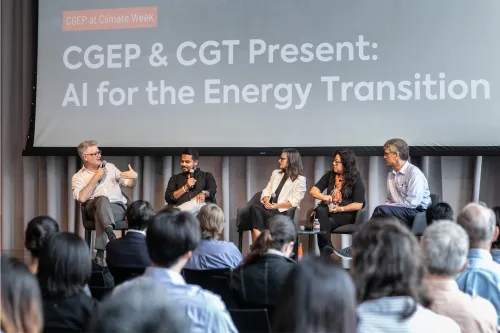
Rather than starting from a disciplinary or regional perspective, the Committee on Global Thought begins with a fundamental question: how should we understand the global itself?
When the Committee on Global Thought was founded in 2006, its agenda was shaped by a historical moment characterized by accelerating globalization. CGT’s scholars were thus engaged in understanding the increasing importance of global cities; the rapid flows of ideas, aesthetic forms, and political projects across borders; and new forms of financial integration and deterritorialization. The counter-forces gathering opposition to these global processes have intensified in the years since. Globalization now coexists with resurgent nationalism and xenophobia, ongoing military conflict, increasing global inequality, and authoritarian and anti-democratic movements.
CGT provides a forum in which to make connections within and outside the university, among scholars across disciplines who are committed to thinking and acting in the world today. Chaired in succession by Joseph E. Stiglitz, Saskia Sassen, Carol Gluck, Vishakha N. Desai, Reinhold Martin, and now Adam Tooze, CGT today consists of over 35 distinguished faculty members from across Columbia University’s schools and departments. Their scholarship, while remarkably diverse, is linked by an insistence that we need to engage global and interdisciplinary perspectives in order to comprehend our current moment. In this respect, even seemingly disparate lines of inquiry often prove to be intertwined.
Check out the Year in Review page to learn more about our activities.
CGT’s intellectual project, along with its pedagogical programs, isn’t so much attached to particular problems as it is to thinking about how we frame those issues. What are the politics of global knowledge? What are the logistics of thought? We ask open-ended questions, rather than follow a preset agenda, in order to talk with—not at—our counterparts and collaborators wherever they may be. The intellectual goal is to view things in global context, not to define or confine “the global” to any fixed definition.
Our programs reflect this approach: a robust Master of Arts in Global Thought, undergraduate courses in Columbia’s Core curriculum, a selective, cohorted Global Thought Scholars program, and the Undergraduate Committee on Global Thought.
In addition to its pedagogic offerings, CGT convenes:
- Public programs that interrogate urgent global issues from multiple intellectual perspectives in a transnational frame.
- Signature research projects, including The Post-Western Offshore System: Regulatory Fragmentation and the Rise of New Financial Secrecy Hubs, Politics of Visual Arts in a Changing World, and Youth in a Changing World.