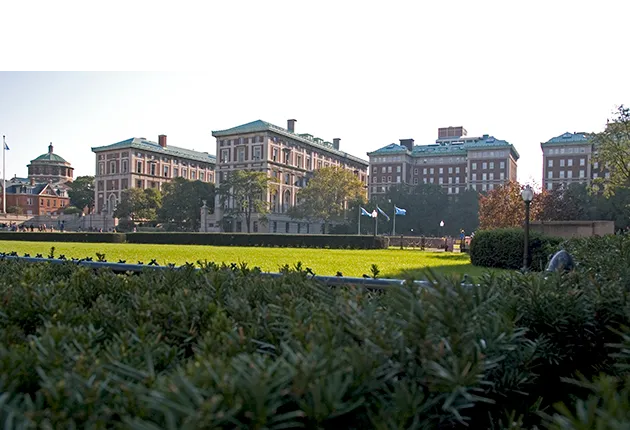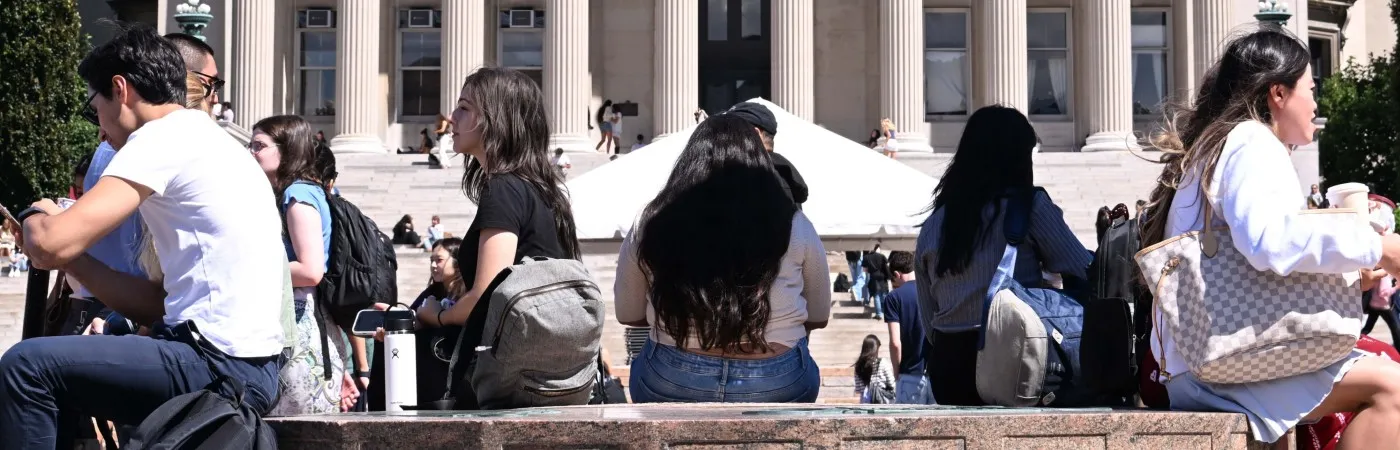
Global Thought engages undergraduate students through courses, extracurricular opportunities, and a selective scholars program.
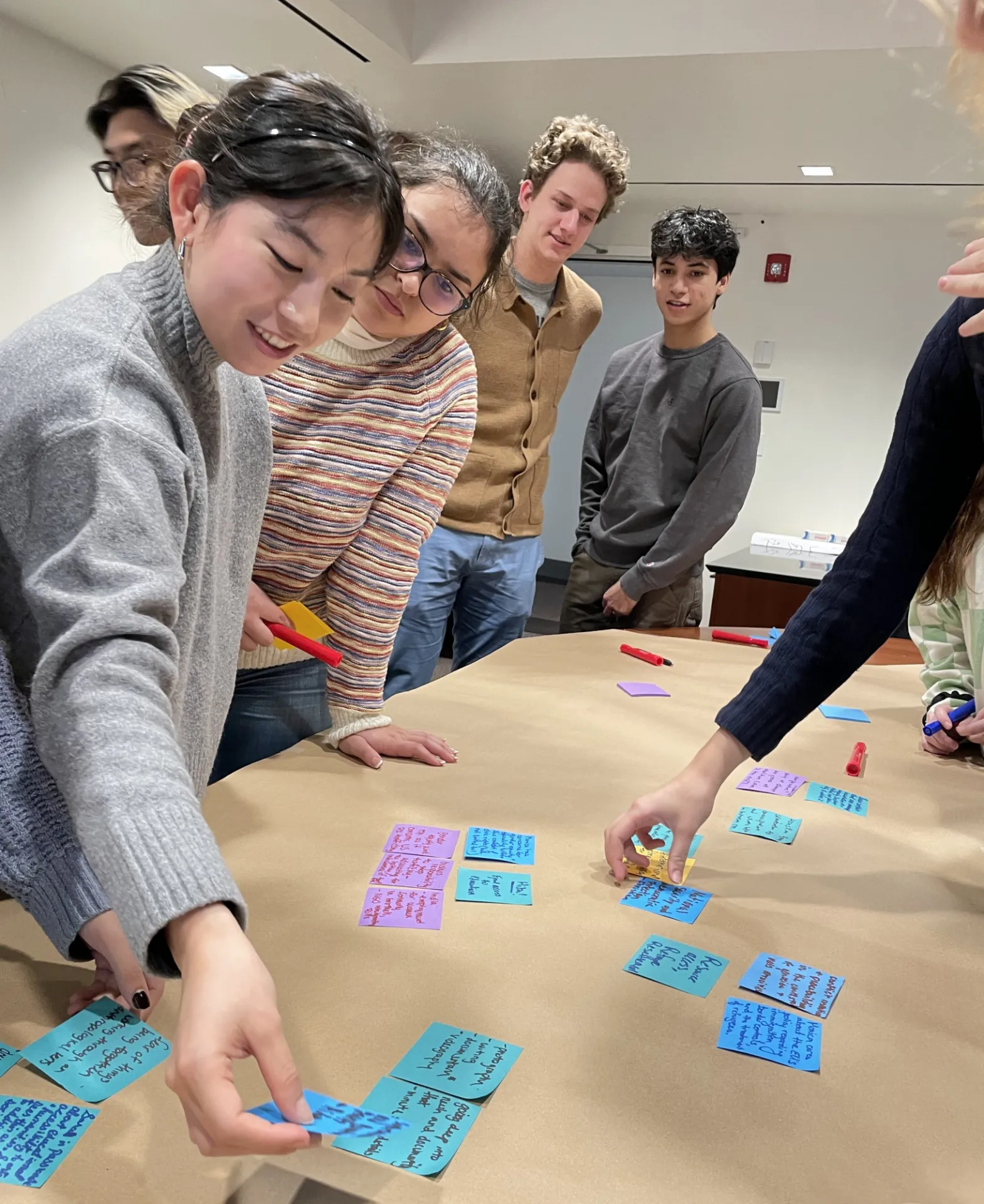
"The spirit of inquiry, rooted in empathy and openness, is something I will carry forward in both my scholarship and my life beyond Columbia."
—Albaraa Gebril, Global Thought Scholar '25
Undergraduate Courses in Global Thought
Committee on Global Thought continues to expand its course offerings.
Current Courses
A Global Core eligible course, tackles big questions related to globalization by tracing the history and contemporary production and consumption of textiles fashioned into cloth and clothing. From the ancient silk trade and early modern production of cotton and cotton textiles in the context of conquest, imperialism, and industrialization, to the fast fashion industry of today, textiles have interwoven the world and “fashion” manifested the global circulation of ideas about class, gender, race, and nationality. Studying globalization through textiles and clothing reveals the power dynamics underlying global interconnection and the unevennesses produced by it. It also challenges concepts of cultural essentialism by underscoring the hybridity of human societies and individual identities in an interwoven world.
A Global Core Eligible course, asks what it means to be a young person today as the world confronts seismic shifts in the geopolitical order, in the nature and future of work, and in the ways we connect with each other, express identity, engage politically, and create communities of belonging.
A required course for Global Thought Scholars, introduces students to transdisciplinary approaches necessary to address complex problems confronting the world today. The course places students into conversation with others of diverse backgrounds, passions, and majors to consider the approaches of their own disciplines, learn about the methodological “tool kits” of other fields, investigate examples of transdisciplinary research, and work with classmates to design their own problem-centered collaborative projects.
Joint Undergraduate/Graduate Courses
Explores, from a critical political-economy perspective, the nexus between urban space and the global capitalist system. Specifically, we will analyze how global capitalism makes and remakes contemporary cities, including the built environment and socio-spatial dynamics therein, but also the dialectical processes through which cities and spatial logics simultaneously reshape global capitalism and its geographies of accumulation. Throughout, we will engage with diverse, transdisciplinary interlocutors, sources, and media to highlight not only the links between the contemporary city and the generation and/or perpetuation of inequalities, social hierarchies, and environmental degradation—but also alternative models for affordable housing, climate-friendly construction, and the democratization of urban space.
Is a course that, in contrast to the “methodological nationalism” (or “regionalism”) that has long characterized outside analysis of Latin America, foregrounds the region’s global embeddedness and world-making potential—as a protagonist in the generation, adaptation, and diffusion of diverse border-crossing flows, frameworks, and imaginaries. These include: global discourses concerning modernity, postmodernity, liberalism, and postcolonialism; global understandings of race, class, gender, and the intersections between them; global policy frameworks related to human rights, democracy, and economic development; historical and contemporary globalizing relations with distant parts of the world, including the Middle East and Asia; and global alternatives to a world order based on exclusion, extractivism, and environmental degradation. Accordingly, we will engage with a series of texts and materials produced by diversely situated interdisciplinary scholars, writers, artists, and political figures—many of them based in Latin America, and operating in languages other than English—who are all seeking to make sense of the region’s place in the world. From a transnational perspective, we will also identify pockets of “Global Latin America” that exist beyond the region’s borders, including in parts of New York City.
Asks: How did New York go from “Fear City” to “Capital of the World”? What historical structures, contingencies, and policy decisions produced Global New York? This course examines New York City’s long history as a site of globalization. Since European colonization, New York has served as a hub in world-spanning networks of capital, goods, and people. At the same time, the city’s reinvention in the late-20th century as a “global city”—defined in large part by its deep embeddedness in world financial markets—represented a fundamental shift in the city’s economy, governance, demography, cultural life, and social relations. We will interrogate how this came to be by exploring New York’s historical role in global business, culture, and immigration, with attention to how local and national conditions have shaped the city’s relationship to the world. While critically analyzing how elites both in and outside New York have wielded power over its politics and institutions, readings and discussions will also center the voices of New Yorkers drawn from the numerous and diverse communities that make up this complex city.
Global Thought Scholars
Applications are closed for the 2025-2026 Global Thought Scholars Program. Details about the 2026-2027 program will be available by fall 2026.
Urgent challenges confronting our world today require new and cross-cutting ways of thinking and acting. Global Thought Scholars are trained to think globally about issues of importance to them and to develop their own research projects in collaboration with classmates of diverse majors and disciplinary approaches.
We welcome sophomores and juniors of all majors from Columbia College, General Studies, SEAS, and Barnard. Scholars will be chosen for their academic record, commitment to new ways of learning, and diversity of backgrounds and disciplines.
Program Structure
Benefits
Applicants should apply in their sophomore and junior years. Complete the application and upload a resume and transcript (unofficial is fine).
Questions? Email the Committee on Global Thought, Assistant Director of Academic Programs, Farryl Last.
Undergraduate Committee on Global Thought
The Undergraduate Committee on Global Thought (UCGT) hosts an annual conference exploring a theme of particular interest to the undergraduate community. Bartsch Fellows of the UCGT and the UCGT Core Committee conceptualize, research, and lead conference workshops. Learn about past conferences.
BA/MA Program
The Committee on Global Thought accepts applications for its BA/MA program, which is available only to current Columbia undergraduates (enrolled at Columbia College, the School of Engineering and Applied Science, the School of General Studies, or Barnard College), who want to add an MA in Global Thought to their achievements at Columbia University. Click the Apply button below to learn more about the program and about how to apply.