00:30 of myself and my family, uh, were important, not just how I was acting sort of outside in school. I definitely think that shaped me
00:54 and I see really big contrast between the two and it's something that I always try to resolve within myself,
01:00 but also resolve in how does global inequality arise? Why do cultures differ so much from each other, and how can we bring people closer to each other?
01:15 CGT feels different from other academic spaces I've been a part of because they sort of let you choose your own adventure
01:20 and decide how you want it to handle the degree. I really loved that, but also loved having a home base.
01:25 I love seeing all of my classmates like once a week in MA seminar, but still doing my own thing
01:29 and my different electives. So it was really nice to explore and figure out what I personally wanted to do at Columbia while also knowing I had a cohort
01:36 supporting me and faculty and staff supporting me as well. I think what surprised me most about the CGT curriculum is
01:48 how invited we were to learn from each other as resources. I think that was the best part of the program by far.
01:54 I think people and their lived experiences can teach you so much more than any research or textbook can, and I loved that, you know,
02:01 it wasn't just allowed, it was encouraged. I definitely think the faculty support at CGT was amazing knowing there was someone there every step of the way,
02:08 knowing I could email whenever any questions I had and I never was made to feel silly about the questions
02:13 or my concerns or my ideas. Even just being supported every step of the way. It was great. I think a class that really set the tone for me, uh,
02:21 was one of our first seminars where Adam twos explained how to poly crisis at working and he really emphasized that one of the skills you need
02:30 to have if you're gonna be studying global thought is to lean into the uncertainty but still dare to step forward and take action.
02:38 And I think that really changed the way that I, uh, like took all classes and like positioned myself within the classroom.
02:45 After that. If I could sum up my CGT experience in one word, um, I would use the word tapestry.
02:57 It kind of felt like we were all individual, uh, elements in one beautiful artwork, art piece of tapestry of different ideas, different ideologies,
03:07 different backgrounds, different people. There's so many interesting courses that Columbia offers, uh, and CGT offers you the opportunity to really explore that.
03:16 And I was really drawn into the international perspectives within the classroom. We’re 36 students from 24 different countries, and I feel like that also adds so much to a class discussion
03:26 that there's people that have actually lived in so many different places in the world. The most important thing I learned in the
03:37 program was just to listen. Um, a lot of amazing discussions were had and a very substantial thoughts were formed
03:43 because of people's, uh, willingness just to listen, uh, and learn from a lot of people from all different contexts
03:48 and all different corners of the globe. I think the ability to listen and learn from my classmates really helped me build up
03:53 communities from the ground up. Um, recognizing that every voice sort of has a power, every story is important and that that all needs
4:00 to be incorporated into the solution.
A Unique Graduate Program
The MA in Global Thought is a distinctive degree that challenges students to think critically, think capaciously, and think globally to address the complexities of our interconnected and ever-changing world. The program’s interdisciplinary, customizable curriculum and unparalleled support prepare students for a range of careers across disciplines and borders. Through engagement with scholars from a wide range of experiences and disciplinary backgrounds, and by learning from each other, students are encouraged to embrace curiosity, nuance, and open-ended analysis.
This unique degree creates a space where students are exposed to new ideas while empowering them to develop expertise in their area of interest. The curriculum, which combines a robust set of core classes with the opportunity to take electives across Columbia’s numerous world-class graduate schools, means that each member in the diverse and closely connected cohort forges an individualized course of study tailored to their intellectual pursuits and personal aspirations.
Reflecting the openness of the Global Thought approach, students in the MA cohort are drawn from all over the world and from a wide range of disciplinary experience in the social sciences, humanities, and STEM fields. Whatever their background, students will come away from their time at Global Thought with a transformed understanding of the world and their place in it.
The MA in Global Thought prepares students to tackle complex global issues in the classroom, future workplaces, and the public sphere.
Check back in the fall to sign up for information sessions, and in the meantime, read more about what makes Global Thought unique, degree requirements, and how to apply.
What is Global Thought?
Global Thought is an open-ended approach that enables scholars to explore problems that demand perspectives across disciplines and borders. Global Thought scholars ask critical questions rather than offer prescriptive answers to global problems. This conceptual framework for analyzing global relations is contingent, iterative, and dynamic, seeking to respond to the urgency of our moment by marshalling a diverse range of expertise, theory, and academic traditions. By understanding global thinking as a process rather than a product, our programs develop original insights about the changing world, drawing upon local views of global processes that affect all of us, if not in the same way.
Global Columbia in Global New York
Located in the vibrant neighborhood of Morningside Heights in Manhattan, Columbia has led the effort to reimagine the university for a globalizing world. Global Thought students benefit from access to Columbia’s outstanding faculty, resources, and campus events as well as the countless intellectual and cultural opportunities in global New York. Throughout the year, MA students participate in numerous activities throughout the city, including a visit to the United Nations, a naturalization ceremony in Brooklyn, and an architectural boat tour in New York Harbor. Global Thought electives also encourage students to take advantage of all that New York has to offer by incorporating excursions to the city’s museums and notable neighborhoods.
What Makes Global Thought Different?
While the MA in Global Thought tackles many of the same topics covered in traditional international relations programs and foreign affairs scholarship, it does so through an interdisciplinary lens and flexible curriculum that allows students to ask novel questions and pursue unique research interests. It encourages unconventional thinking, for instance by supporting a humanistic and qualitative approach to subjects that are usually studied using quantitative methods. Global Thought is an exceptional program in other ways as well:
- A strong and dynamic core: Core courses are designed to ground students in global politics and culture, global political economy, and global governance while also responding directly to the urgency of our current moment and to students’ interests and concerns.
- A customizable curriculum: Students take electives at Columbia’s many graduate institutions, including the School of International and Public Affairs, Columbia Law School, Columbia Journalism School, Columbia Business School, the School of Professional Studies, Teachers College, and many other schools and Columbia affiliates.
- Innovative student research: Students design pioneering research projects through their MA capstones, which bring together interdisciplinary methods to understand urgent global problems.
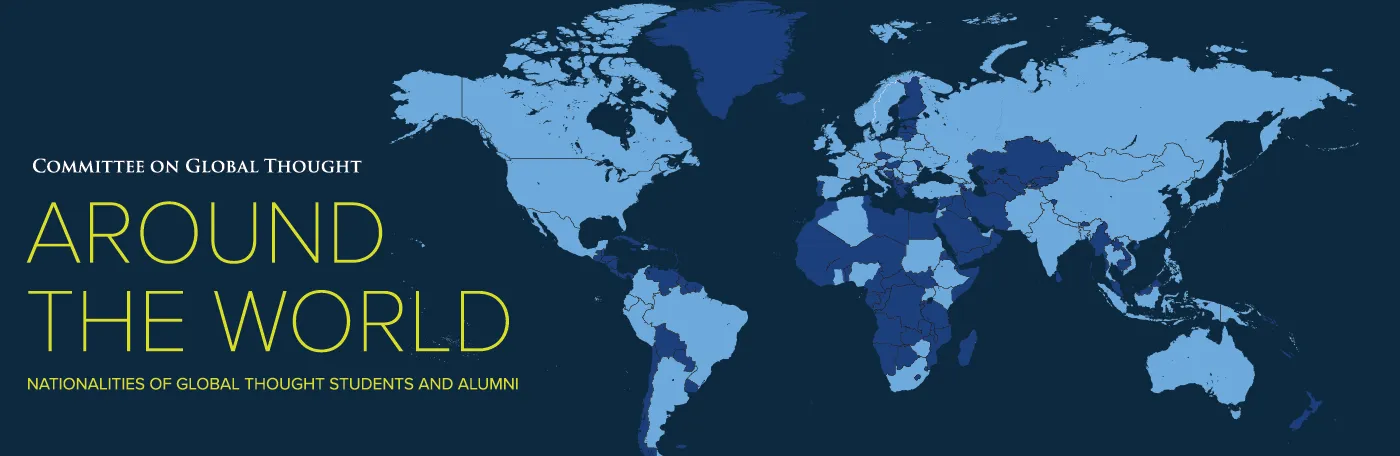
- A remarkable cohort experience: Global Thought programming and core courses ensure the formation of a supportive and inclusive community of students who learn from each other and stay in touch long after graduation. Global Thought cohorts are exceptionally diverse. To date, our students and alumni represent 63 countries!
- Hands-on support throughout your academic journey: During their time at Global Thought, students receive unparalleled personalized advising and support from staff and faculty.
- An enduring and engaged alumni community: With regular alumni events and other opportunities to stay engaged with Global Thought, graduates form deep and durable connections within and across cohorts. See more about our alumni here.
The Global Thought program is customizable, interdisciplinary, and globally diverse.
The Degree
The Global Thought curriculum offers an ideal balance of structure and flexibility. The Core includes a two-semester MA seminar and three additional courses that provide a broad-based conceptual and interdisciplinary foundation in global governance, global political economy, and global politics and culture. In the MA seminar, students become familiar with diverse methods of academic inquiry, are introduced to the pioneering research produced by Columbia faculty and outside experts, participate in writing workshops, and undertake their own original research projects culminating in an article-length essay. MA Seminar also serves as a weekly gathering space that amplifies the cohort experience.
In addition to their core courses, students design a flexible plan of study by choosing from the thousands of electives offered across Columbia’s departments and schools, which they leverage to complete their capstone essays.
Learn more about the degree structure here.
Students may complete the degree on a full or part-time basis.

Cutting-Edge Student Scholarship
Global Thought students forge their own research path with robust support from their academic advisor. Subjects range across the most pressing global concerns of the day and engage cutting-edge scholarship in fields such as critical migration studies, technology and society, political economy, and media and cultural studies.
In past years, capstone essay projects have covered topics including populism as a global phenomenon, gender and international development, surveillance capitalism, biopolitics, local impacts of climate change, and the future of employment in a world of artificial intelligence. You can see more past projects here.
"The MA in Global Thought program is the epitome of interdisciplinary learning and provides students with the ability and platform to engage with diverse courses. We had the opportunity to take classes from all of Columbia’s schools and interact with and benefit from the wide variety of resources the university has to offer."
—Shagun Sethi, Class of 2020
A Career Without Borders
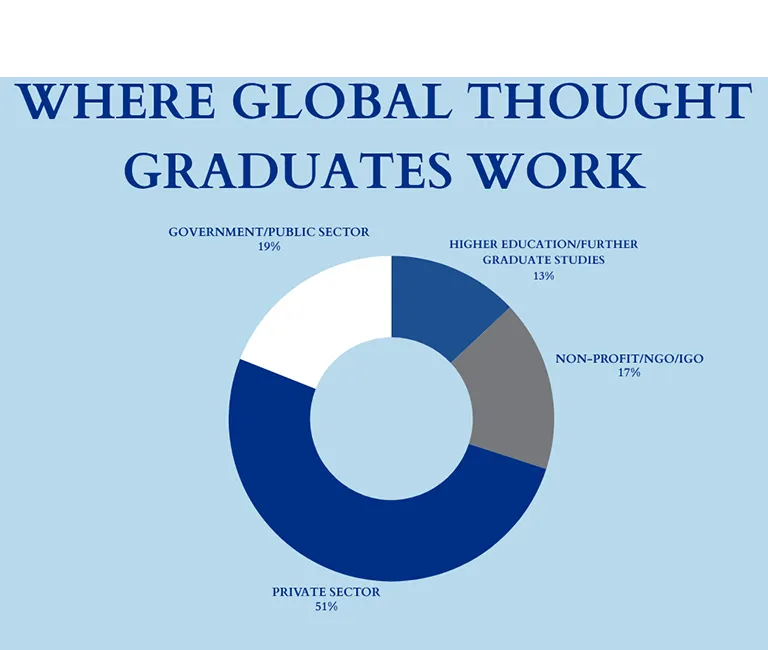
Graduates are prepared for a wide range of careers in government, civil society, academia, and the private sector. The MA in Global Thought is neither a professional nor a vocational degree but an intellectual foundation for transnational and interdisciplinary approaches to thinking about and working effectively in the world.
To learn more about professional development opportunities on the Career Support page.